
THE MAYOR IS LEAVING. THE NARRATIVE ISN’T.
Peterborough, Protest, Intimidation and the Evidence Left Outside the Richmound Story

CBC News — Saskatchewan mayor stepping down now that ‘Queen of Canada’ cult is gone
The Canadian Press — Saskatchewan mayor who clashed with ‘Queen of Canada’ cult to leave top job
Brad Miller is stepping down in mid-October after three years as the public face of Richmound’s conflict with the occupants of the former school. The resignation coverage largely preserves the story Canadians have heard from the beginning. But when the Peterborough history, Miller’s own statements, the truck convoy, RCMP warnings, sewer records, July 18 confrontation, firearm allegation, stayed intimidation charge and other evidence are restored to their proper chronology, the picture becomes considerably more complicated.
RICHMOUND, Saskatchewan — Brad Miller is leaving the mayor’s office.
The conflict that made Richmound nationally recognizable has effectively ended. The people who occupied the former school are gone. Romana Didulo is no longer living there. Miller says the village can begin a new chapter.
Yet the resignation coverage supplied for this review reads remarkably like the coverage that accompanied the conflict itself.
Richmound was overwhelmed by a “cult.” Residents were afraid. Threats were made. Utilities were cut off. Sewage appeared. Police eventually raided the property. The occupants were removed. Miller and the village had finally “won the war.”
That is a simple story.
The accumulated evidentiary record is not.
This article continues three earlier A.I. Truth News reporting that examined the infrastructure dispute, public-health narrative and September 2025 police operation. This follow-up looks more closely at Miller’s role in the conflict — and at how Peterborough, fear and the campaign to remove the school occupants became intertwined.
For three years Miller was usually presented as the elected official reacting to events created by somebody else. But Miller was not merely standing outside the conflict describing what was happening.
He publicly announced the outcome he wanted.
He participated in an organized public campaign demanding that the occupants leave.
He invoked an Ontario citizens’ arrest to explain why Richmound should anticipate future danger.
He was physically present during one of the most consequential confrontations at the property.
He became part of the information chain that carried a later firearm allegation to police.
And eventually, while the people at the school were being accused of intimidation, the evidentiary record contained extensive allegations that intimidation and organized pressure had also been directed toward them.
That chronology deserves to be told before the Richmound chapter is declared finished.
Miller stated the objective near the beginning: remove them
The most useful starting point is not the September 2025 police operation.
It is Miller’s own words in October 2023.
Barely a month after Didulo and her associates arrived in Richmound, Miller told reporters that the community’s focus was to “move her out.” He also spoke about governments becoming involved and working with RCMP to “push people out like this.”
Those statements came long before the later events used to support removal.
Before July 18, 2025.
Before the major sewer confrontation.
Before the rooftop-rifle allegation.
Before the September raid.
The desired result had already been publicly declared.
The messaging was also organized. The October press conference was introduced by a media-relations specialist assisting Richmound with media inquiries. A media advisory had been distributed, political figures and neighbouring mayors appeared, and reporters from across Canada and internationally were following the event.
Richmound was no longer merely a local disagreement.
A national narrative was forming.
And one of its most powerful warning examples had already been created in Peterborough.
Peterborough became the warning label
In August 2022, supporters associated with Didulo attempted citizens’ arrests at the Peterborough Police Service in Ontario.
CBC National coverage reviewed for this article demonstrates how the incident was introduced to a national audience: the participants’ COVID-era grievance was mentioned briefly before the story moved rapidly into arrests, an alleged assault, hostile political commentary, “extremist cult” language and expert discussion about fringe movements becoming real-world threats.
The headline version was memorable:
Didulo supporters tried to arrest police.
The preceding year was not.
For approximately a year before August 13, the principal organizer repeatedly attended or contacted Peterborough Police, spoke with officers and senior members, wrote emails, requested investigation, attempted to provide evidence, sought clarification and openly discussed contemplated citizens’ arrests. About six months before August 13, police were specifically told that the process might begin at their own station.
His concerns had also become deeply personal.
According to his account, his mother-in-law died from a blood clot shortly after receiving a COVID-19 vaccine, and he believed the vaccination had caused the fatal clot.
On June 6, 2022, he brought that death directly to Peterborough Police. He asked officers to use their investigative skills and sought examination or referral of what he believed was a vaccine-related death within his own family. The evidentiary record specifically identifies that encounter and his request for investigation.
That placed something far more concrete than a general political objection inside the chronology leading to August 13.
A close family member had died. A blood clot had been identified. The death followed vaccination closely enough that he believed a connection required investigation. He went to police asking them to determine what had happened.
Whether vaccination caused the fatal clot was precisely the question he was asking authorities to investigate.
The evidentiary record describes approximately fourteen months in which he identified himself, delivered written material, spoke with senior police, offered evidence, repeatedly returned to the station, asked officers to verify information and requested investigation. It also records that he reported what he believed was a vaccine-related death involving his mother-in-law and again asked police to investigate.
By January 2022, police knew citizens’ arrests were being contemplated.
By February 11, police had been told exactly where the organizer intended to begin: at the Peterborough Police station itself.
That left approximately six months between explicit advance notice and August 13.
August 13 was the culmination of a documented year of warnings, requests and police contact — not an event without antecedents.
Then came the doorway encounter.
At the rear entrance doorway, police records alleged that an officer had been grabbed or pulled.
Arrests followed.
But the encounter had been recorded.
The 40-second recording complicated the story
The complete doorway video lasts only about 40 seconds.
The evidentiary record identifies the complete recording as directly challenging the alleged physical grab described in the police account.
When the video was later presented in court, the Crown controlled the playback. The displayed image was enlarged or zoomed at the critical point and the recording stopped before the interaction had ended.
The judge said in substance that he had “seen enough.”
The accused objected and expressly asked that the approximately 40-second recording simply be played from beginning to end.
It was not.
The three other defendants subsequently received stays.
The Crown continued against the remaining accused and relied on his statement:
But by that point Peterborough Police had already locked the public doors, shut down the phones, turned members of the public away and substantially suspended normal public-facing service as part of its own operational response.
That leaves an obvious factual question:
What did those words actually prevent that police had not already made unavailable themselves?
That fuller Peterborough chronology almost never accompanied the shorthand that later travelled west.
Miller personally carried Peterborough into Richmound

By June 2024, the Peterborough incident was not merely something journalists were mentioning around the Richmound story.
Miller himself invoked it.
In a CBC interview reviewed for this article, Miller spoke about worried families and children, argued that higher levels of government needed to intervene, and referred to the principal Peterborough organizer and others associated with Didulo as “clowns.”
His warning was prospective: if those people came into Richmound and “did something,” he said, by then it would be too late.
That interview matters because the sequence becomes clear.
Peterborough had first been nationally framed as an example of a fringe movement crossing from rhetoric into real-world danger.
Then the Peterborough example itself was reused in Richmound as evidence of what might happen there.
But the complete Peterborough history did not travel with it.
The year of police contact did not.
The advance notice did not.
The family death brought to police did not.
The disputed grab did not.
The complete 40-second video did not.
The incomplete courtroom playback did not.
The three stays did not.
Peterborough arrived principally as a symbol of danger.
From “genetic bio-warfare” to gain-of-function, laboratory research and the questions institutions are now asking
To understand why Peterborough acquired that symbolic power, the chronology has to go back another year.
On May 28, 2021, the cease-and-desist was issued as a broad institutional notice. It was addressed to the Prime Minister, federal and provincial health authorities, premiers, police chiefs and RCMP, mayors, the Armed Forces, doctors, nurses and pharmacists, with copies directed to military authorities outside Canada.
According to online distribution accounts, the document was subsequently served or circulated to tens of thousands of individuals and institutions across Canada and internationally.
This was not a warning quietly delivered to one police station or one level of government.
It was designed as mass notice.
And at the centre of that notice were two words that would help define how its author and supporters were treated for years afterward:
“genetic bio-warfare.”
The document demanded an end to COVID-19 vaccination and experimentation, PCR testing, masking, lockdowns and quarantines.
The “genetic bio-warfare” description became inseparable from the public characterization of the people associated with the document.
Five years later, however, the centre of the discussion has moved considerably closer to the territory that phrase was pointing toward.
Gain-of-function coronavirus research is now part of congressional and scientific scrutiny.
Laboratory-origin questions have moved into formal investigation.
Funding relationships involving government agencies, research organizations and coronavirus laboratories have been examined.
Biological research with dual-use and biodefence implications has become part of the discussion.
Scientists and researchers are examining experimental manipulation, laboratory safety, funding, research oversight and the origins of SARS-CoV-2.
Some scientists and researchers have pushed the debate further, publicly questioning whether aspects of coronavirus research should be examined through a bioweapon or biological-warfare framework.
These are no longer questions confined to obscure online discussions.
The evidentiary record reflects how far the inquiry has moved. By 2026, scientists, researchers, congressional investigators, government bodies and criminal investigators were examining coronavirus research, gain-of-function work, funding relationships, laboratory-origin questions, record concealment and institutional decision-making.
Those were also the kinds of records and questions the Peterborough organizer was asking police to examine years earlier.
His 2021 correspondence asked police to review research material and allegations surrounding the vaccine rollout. His repeated demand was investigation: gather evidence, test it and determine where it led.
The later official record moved substantially further.
In April 2026, the U.S. Senate Permanent Subcommittee on Investigations held a hearing examining alleged failures to detect COVID-19 vaccine safety signals. In June, the same subcommittee held another hearing examining proposed mechanisms of serious harm and attacks on scientific research.
In Canada, the National Citizens Inquiry heard hundreds of testimonies concerning vaccine injury, censorship, professional discipline and institutional harm. The Allison Inquiry then sat on Parliament Hill from September 8 to 11, 2026, hearing further testimony concerning alleged vaccine injuries, warnings, adverse-event information, institutional responses and accountability.
Health Canada’s archived surveillance identified myocarditis and pericarditis as confirmed COVID-19 vaccine safety signals requiring regulatory attention. By 2026, Members of Parliament were formally asking when authorities first received reports of deaths and serious adverse events, what Canada knew about early myocarditis signals, what communications occurred with manufacturers and when informed-consent guidance changed.
The research-origin side of the story was moving as well.
In August 2026, former NIAID senior adviser David Morens pleaded guilty in a U.S. federal case involving concealment of federal records connected to coronavirus-research grants. The evidentiary record describes admitted use of a personal email account to hide communications from ordinary federal-records processes.
That creates a striking historical reversal.
In 2021, “genetic bio-warfare” helped turn the speaker into the story.
By 2026, the public record was examining gain-of-function research, laboratory origins, biodefence and dual-use research questions, coronavirus funding relationships, record concealment, vaccine safety signals, adverse events, informed consent and institutional handling of dissent.
Researchers have also pushed the inquiry further into a question once treated as outside respectable discussion:
Could aspects of coronavirus research or its products properly be examined through the framework of biological warfare?
That question is now being asked.
And that matters enormously to Peterborough and Richmound.
Because the organizer of the Peterborough citizens’ arrest spent more than a year asking police to investigate material connected to these subjects.
The later national story remembered the citizens’ arrest.
It largely forgot what he had been asking police to investigate.
Then Miller carried that shortened Peterborough story into Richmound and used the organizer himself as part of his warning about what might happen there.
The historical question is therefore much larger than whether people approved of the words “genetic bio-warfare.”
It is this:
What happens when institutions dismiss the investigator because of the accusation — and years later begin investigating the very categories of evidence that accusation was pointing toward?
There is another distinction that should remain clear.
The original May 2021 cease-and-desist is a specific two-page document. Later threatening communications associated with the Richmound controversy were separate material.
Miller himself acknowledged uncertainty about the origin of at least one later communication, saying an IP address made it difficult to determine where it originated and “who pushed the button.”
Document, date, author and provenance matter.
Especially when threatening material becomes part of a public-safety narrative.
Then the removal campaign became physical
Miller’s public demand to remove the occupants did not remain an interview position.
Rallies and a truck convoy followed.
At the October 2023 press conference, participants discussed the rally taking place that day and an earlier one. The purpose was stated directly: the rallies were intended to show community support “so that we can let them know that we don’t want them to stay.”
Photographs reviewed for this article show the message in even simpler terms:
“GET OUT.”
“LEAVE.”
Video evidence records truck horns being sounded repeatedly throughout the day during the convoy activity.
That detail matters because Canada had only recently gone through an intense national debate over convoy protest, truck-horn use, disruption and the effects of organized demonstrations on people forced to live beside them.
The Ottawa and Richmound events differed greatly in size, duration and circumstances.
But one evidentiary question applies to either:
What was the protest doing to the people receiving the pressure?
RCMP themselves warned the Richmound demonstrators about intimidation
A Saskatchewan RCMP “Notice to Demonstrators” reviewed for this article makes the point unusually clear.
The notice reminded demonstrators of their ability to assemble while specifically warning against acts of intimidation or mischief.
It warned against obstructing roads and interfering with the lawful use or enjoyment of public or private property.
It also advised that unlawful conduct could result in arrests, vehicle seizures and criminal charges.
Most importantly, the notice specifically referred to the Village of Richmound Protest Group and gave organizers instructions concerning the demonstration area.
A screenshot reviewed for this article shows Miller’s social-media account sharing that RCMP notice on October 13, 2023.
Another Saskatchewan RCMP notice announced a temporary mobile detachment in Richmound operating 24 hours a day, seven days a week, together with regular patrols. Police said they had received reports involving assault, threats and suspicious persons.
The demonstrations were therefore occurring within an environment already known to police.
RCMP knew protests were being organized.
RCMP expressly warned demonstrators about intimidation and mischief.
And Miller had the warning.
That becomes important later, when intimidation itself becomes a criminal allegation against Manz.
The people inside said they were being intimidated too
Court materials describe the occupants’ position very differently from the dominant public narrative.
They alleged sustained public hostility, organized protests intended to get them out, stigmatizing political and media commentary, harassment, surveillance, intimidation and trespass.
That provides important context for the fencing and cameras that later became recurring visual symbols in media coverage.
Miller himself complained publicly that people associated with the school were going around filming and taking photographs.
But cameras also preserve evidence.
And later, video would become central to one of the most consequential confrontations of the entire Richmound conflict.
Another accusation that collapsed before trial
Before July 2025, Manz had already been arrested over another alleged assault in Richmound. He maintained that video showed he never struck the complainant.
When the case finally came to trial in November 2024, the complainant did not appear. The Crown stayed the assault charge.
The accusation had already travelled through police statements and headlines. The video Manz said contradicted it was never tested in court because the complainant did not show.
That episode also helps explain something repeatedly portrayed as suspicious in the Richmound story: the constant presence of cameras.
By then, recording was becoming more than documentation. For Manz and those associated with the school, video was becoming an essential means of preserving an independent record whenever they interacted with police, officials, protesters, journalists or members of the public.
When accusations could be made after an encounter, the camera preserved what actually happened.
That makes the later videos — including July 18 — part of a much larger evidentiary pattern.
July 18 did not begin at the fence
The July 18, 2025 confrontation is often presented as a dispute over municipal access.
That is where the visible confrontation happened.
It is not where the story began.
Village council minutes reproduced in later court materials record an earlier discontinuation of sewer service associated with the property.
The Village’s sewer policy distinguishes the municipal eight-inch main from the property-owner-responsible service connection and assigns responsibility for maintaining and clearing that connection.
Manz’s later pleading alleges interference with essential sewer and water service and alleges that written notice was not provided before municipal access was attempted.
On July 18, RCMP members and municipal figures including Miller attended the property, and video captured the incident.
Defence disclosure materials later sought texts, emails requesting RCMP attendance, phone communications involving Miller and other municipal participants, municipal legal communications concerning removal and public-works records relating to the sewer.
Those records matter because the decisive questions begin before anyone reaches the fence:
Who arranged the attendance?
What were police told?
What notice had been given?
What had already happened to the sewer service?
What did municipal officials intend to accomplish that day?
The confrontation is the end of that sequence, not the beginning.
Then the infrastructure dispute became a sewage story
After July 18, one word increasingly dominated coverage:
sewage.
The image was powerful and easy to understand.
But defence disclosure materials sought health and environmental records capable of testing what the water contained, where it originated and what engineering or environmental evidence existed concerning the sewer system.
Those questions matter because the physical evidence should determine the description:
What was in the water?
Where did it originate?
What infrastructure condition caused it to accumulate?
What did testing show?
A dramatic image can shape a headline.
The underlying physical record determines what actually happened.
Then came the rifle Miller never saw
On August 25, 2025, another allegation transformed the situation.
A rifle had reportedly been seen on the roof of the former school.
Miller contacted RCMP.
But Miller had not personally seen the alleged firearm.
Police material reproduced in later court filings records the information travelling through several people before reaching police.
One vehicle-delivery worker said he had seen what he believed was a scoped rifle.
The other did not see a rifle.
The reporting witness said he was approximately 150 feet away and could not determine the calibre or exact type. Police records reproduced in the filing also contain differing descriptions of where the object was allegedly positioned.
A search warrant followed.
Police executed the warrant at the former school on September 3.
The later court filing states that no firearm or ammunition was located on the applicant or property and that no firearm charges were laid against anyone present.
Again, the information chain matters.
A distant observation.
A second witness who saw no rifle.
A relay through another resident.
Then Miller.
Then police.
Then a warrant.
Then a major operation.
That full chain belongs beside the phrase “gun at the compound.”
Miller’s own firearm appeared in an entirely different frame
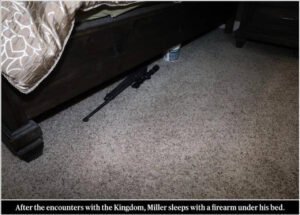
The firearm issue becomes more interesting when compared with a photograph published in coverage of Miller himself and reviewed for this article.
The photograph appears to show a long gun beneath or beside Miller’s bed, with what appear to be ammunition-related items nearby.
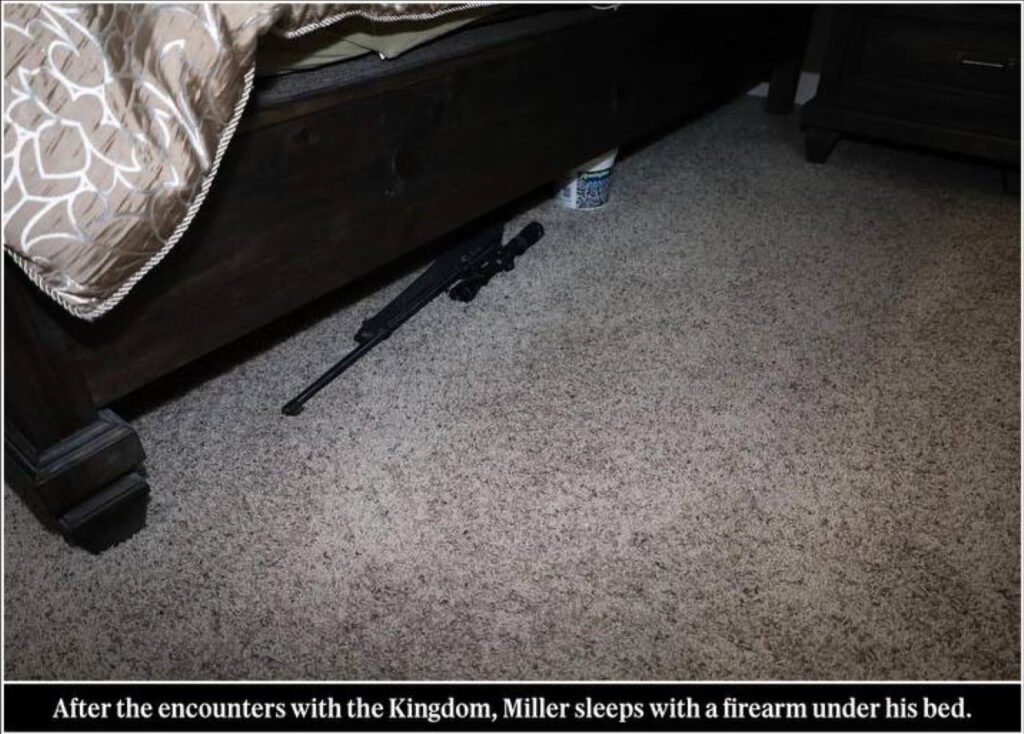
It was presented in the context of Miller describing his fear.
The contrast in framing is notable.
At the former school, Miller had not personally seen the alleged rooftop rifle. One direct witness did not see it. The witness who did report one was approximately 150 feet away and could not determine the type or calibre.
That allegation became part of a police investigation that led to a search warrant and major operation.
At Miller’s home, a firearm was visibly photographed in his bedroom while the surrounding story presented it in the context of the mayor’s own concern for his safety.
The photograph also raises a separate legal-compliance question concerning firearm storage that cannot be resolved from the image alone.
But the media contrast can be stated without deciding that question:
One firearm story was framed as a potential threat associated with the school.
The other firearm image was framed as part of the mayor’s experience of feeling threatened.
Those are two very different narrative functions for firearms appearing in the same conflict.
When complaints travelled in the opposite direction, the response looked different
After the September police operation, Manz later reported an alleged unauthorized entry into the former school, missing property, property damage and related conduct.
His January 28, 2026 written statement identified publicly available video, property allegedly originating from inside the building, graffiti, missing items and damage. He asked police to preserve evidence, investigate the alleged entry and related offences, interview the person he accused and provide an occurrence number and investigation status.
Later correspondence records Manz’s understanding that the decision-maker concluded there was insufficient evidence to proceed with charges; he repeatedly sought written clarification concerning the decision and the handling of the file.
That contrast belongs in the larger Richmound chronology.
An allegation concerning a rooftop firearm escalated toward a warrant and major police operation.
A later complaint alleging wrongdoing against the property travelled a different investigative path.
The evidentiary record allows those processes to be examined side by side.
Then the intimidation charge ran into the history surrounding it
“Intimidation” had enormous power in the Richmound narrative.
Eventually Manz himself faced an intimidation-of-a-justice-system-participant charge.
But by then there was already a substantial record alleging organized pressure running in the opposite direction.
Miller had said the objective was to remove the occupants.
Rallies were held so the occupants would know they were not wanted.
A convoy took place.
Video records repeated horn use.
Signs ordered them to “GET OUT” and “LEAVE.”
RCMP warned Richmound demonstrators directly about intimidation and mischief.
The occupants alleged surveillance, harassment, intimidation and trespass.
That history could have become highly relevant in a full courtroom examination of intimidation.
A defence could have placed the wider environment before the court and asked whether pressure and fear had been operating in both directions.
The intimidation-of-a-justice-system-participant count against Manz was later stayed. A separate proceeding involving Didulo’s alleged contact with Manz was stayed by the Attorney General on March 17, 2026, while Manz’s separate alleged-contact charge remained outstanding.
The evidentiary record does not state the Crown’s reason for staying the intimidation count.
What it does show is the wider environment that could have been placed before a court had that allegation proceeded to full adjudication.
That is why the stay matters.
One of the most powerful criminal labels attached to the Richmound defendants never reached a completed adjudication, while allegations of intimidation directed toward the occupants remained largely outside the national story.
The Ottawa comparison makes that context harder to ignore
The Richmound convoy also sits against a recent Canadian backdrop.
The Ottawa Freedom Convoy had already made horn noise, obstruction and the effects of convoy-style protest on nearby residents a national legal and public issue.
Richmound was much smaller and materially different.
The comparison is therefore not about declaring the two protests legally equivalent.
It is about the lens used to examine them.
In Ottawa, enormous attention was directed toward what prolonged convoy activity was doing to the people living and working around it.
In Richmound, the same basic question deserves examination:
What was the convoy and removal campaign doing to the people living inside the school?
The photographs, video, stated purpose of the rallies and RCMP demonstrator warning make that a factual question, not merely a matter of political sympathy.
The disclosure record should remain separate from the intimidation stay
The disclosure issue is important for a different reason.
A defence disclosure document in the evidentiary record lists the September 2023 “Protest / Convoy Organization” among the events for which records were sought. It also sought material concerning July 18 sewer access, communications with the mayor and council, municipal legal communications concerning removal, water records and sewer work orders.
The same document sought communications involving Miller, council, police, government figures and recurring labels such as “cult,” “QAnon Queen,” “grifter,” “fringe” and “conspiracy theorist,” as well as records concerning complaints of harassment, stalking, intimidation, agitation and surveillance directed toward Didulo and her team.
Those are requests for records.
Their importance is chronological.
They identify material capable of reconstructing how separate episodes may connect:
the removal campaign,
the protests,
the municipal infrastructure dispute,
July 18,
the firearm allegation,
the police operation,
and the media narrative surrounding them.
That is a different issue from why the Crown later stayed the intimidation charge.
The two should not be conflated.
Now Miller is leaving — and the same narrative remains
That brings the story back to the fall of 2026.
The resignation coverage supplied for this review largely restores the same simple structure with which Richmound entered the national consciousness.
A “cult” arrived.
Residents were afraid.
The mayor fought back.
Threats occurred.
Utilities were cut.
Sewage appeared.
Police acted.
The occupants were removed.
The village won.
The mayor can leave.
What is largely absent is the countering chronology accumulated during those three years.
Miller’s early declaration that the objective was to “move her out.”
His call to work with RCMP to “push people out like this.”
The organized rallies and convoy.
The horns.
The “GET OUT” signs.
The RCMP intimidation warning to demonstrators.
The Peterborough history behind the example Miller later used to describe future danger.
The family death brought to police.
The full Peterborough video.
The three stays.
The municipal sewer chronology.
The July 18 video.
The firearm-report chain.
The second witness who did not see a rifle.
The photograph of Miller’s own firearm under or beside his bed.
The complaints travelling in the opposite direction.
The later stay of Manz’s intimidation count.
The defence effort to obtain records capable of reconnecting the sequence.
Those facts do not fit as neatly into the original story.
That is precisely why they deserve examination.
The unresolved question is not whether people in Richmound were afraid
Some clearly were.
The more important question is how that fear was built, communicated and reinforced.
Peterborough supplied an earlier example.
National media had already packaged it as evidence of danger.
Miller later invoked it personally.
The mayor had already declared removal as his objective.
Rallies then communicated that objective directly to the occupants.
RCMP warned the demonstrators themselves about intimidation and mischief.
The conflict hardened.
Infrastructure disputes followed.
The July 18 confrontation occurred.
A firearm allegation escalated the police response.
Then the major operation came.
By the time the public reached the dramatic ending, the assumptions through which those events would be interpreted had been forming for years.
A narrative can build through repetition:
an alarming label,
an official warning,
a dramatic image,
an expert interpretation,
a new incident,
and another headline that arrives inside an interpretation already familiar to the audience.
The mayor can leave. The evidentiary record cannot.
Brad Miller can step down.
The people at the former school can leave Richmound.
The television crews can move on.
The village can try to begin again.
But the evidence remains.
The Peterborough video remains.
The Richmound protest photographs remain.
The convoy video remains.
The RCMP demonstrator notice remains.
The sewer records remain.
The July 18 video remains.
The rifle-report chain remains.
The firearm photograph remains.
The court filings remain.
The stayed intimidation charge remains.
And Miller’s own words remain:
That statement came near the beginning.
His resignation comes near the end.
The years between them deserve to be examined as one chronology rather than as a series of disconnected headlines.
For three years, Canadians were repeatedly told what Richmound was supposed to fear.
The more important task now is to examine what the complete evidentiary record actually shows.
The mayor is leaving.
The narrative is not.
And the evidence is still waiting for the same attention the headlines received.
Legal & Liability Notice: This article includes on-the-ground accounts, primary-source clips, and reporting from third-party outlets. Allegations toward named individuals and agencies are presented with linked sources for reader verification. All subjects are presumed innocent unless and until proven guilty in a court of law. This publication is an exercise of press freedom and fair comment on matters of public interest.