
The Richmound Files
How the case against HRH Majesty Queen Romana Didulo The First collapsed March 17th 2026 — and why the timeline around the Command Center raid, the Natural Law Court matter, and the public narrative demands renewed scrutiny.
The central issue is not simply that charges were later stayed. The deeper issue raised by this file is the chronology itself: a Natural Law Court matter was commenced by Ricky Lee Manz after the July 18, 2025 events, respondents were served and called to attend, and then — only days after service and just before the next hearing date — the Command Center was raided and key people tied to that matter were taken into custody or otherwise neutralized from participation.
Chronology at the Center of This Article
According to the materials found for this article, the timeline that matters is not the simplified headline version later repeated to the public. The timeline begins with the July 18, 2025 incident, continues through the August 4, 2025 Natural Law Court matter, moves through service on the named respondents, and culminates in a raid occurring just before the September 12, 2025 hearing date.
Incident involving Ricky Lee Manz that later became central background to subsequent claims, proceedings, and public framing.
Natural Law Court hearing heard in the case brought forward by Ricky Lee Manz regarding alleged unlawful assault and crimes committed by the RCMP, mayor, and others.
Respondents were served as requested by the judge so they could attend the next hearing and defend the claims made against them.
Deadline identified in the case update for all respondents to respond in file August-4-2025-NL001.
Natural Law Court hearing scheduled for 11:00 AM, with all respondents notified and expected to appear and defend.
The Command Center was raided on the account presented here, with the effect of interrupting, restraining, or displacing individuals tied to the pending matter.
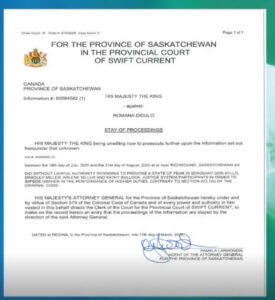
The article background found for this review begins with the March 2026 collapse of the prosecution against HRH Majesty Queen Romana Didulo The First. Crown prosecutors stayed the criminal charges before a preliminary hearing. The allegations were never fully tested in open court. The evidence was never publicly driven to proof. Yet by the time the case ended, the public had already been carried through months of headlines, fear-language, and one-sided framing.
That alone would be enough to justify renewed examination. But the chronology described above goes further. It raises the possibility that the Command Center raid functioned not merely as a law-enforcement event, but as a decisive intervention in the middle of a live dispute in which public officials, police, and other named parties had just been served to answer allegations in a court forum scheduled to continue on September 12, 2025.
“Update for case number August-4-2025-NL001 the case of Ricky Lee Manz – All respondents have been notified, the Respondents have until Sept 5, 2025 to respond The Natural Law Court Hearing will be Held on September 12, 2025 at 11:00 AM.”
How the Public Story Hardened Before the Evidence Ever Was
In March 2026, Crown prosecutors stayed all criminal charges against HRH Majesty Queen Romana Didulo The First, bringing an abrupt halt to a case that had drawn intense local, national, and international attention.
The charges — failing to comply with an undertaking and intimidation of justice system participants — never reached a preliminary hearing. They were not tested in open court. The evidence was never fully aired. The case ended before the public ever saw what the Crown could actually prove.
Yet for nearly two years, the public was fed a steady narrative: that Richmound was the victim of a dangerous occupation, that local officials and residents were merely reacting to a threat, and that law enforcement stepped in to rescue the village from escalating extremism.
Once the prosecution collapsed, that narrative did not become stronger. It became more vulnerable. And when the sequence of events around the Natural Law Court matter is placed beside the later raid, that vulnerability deepens.
1. The Charges Were Stayed Before the Evidence Was Tested
On March 17, 2026, Crown prosecutors stayed both charges. The stay ended the prosecution before the scheduled April preliminary hearing.
This matters because a stayed charge is not proof, not a conviction, and not a finding that the public narrative was true. It is the end of a prosecution before the allegations were carried through to judicial testing.
After months of repetition, the core legal case collapsed without the public ever seeing the allegations proved. That is not a small procedural detail. It goes to the heart of how certainty was manufactured long before proof ever arrived.
2. The Command Center Raid Cannot Be Separated From the Natural Law Court Timeline
The key enhancement required by the chronology is this: the Command Center raid must be examined against what was already underway.
According to the materials found, Ricky Lee Manz had already brought forward a Natural Law Court matter arising from alleged unlawful assault and crimes committed by the RCMP, mayor, and others. That matter was heard on August 4, 2025. The respondents were then served so they could attend and defend at the next hearing. Only days after service — and immediately before the September 12, 2025 hearing they were due to attend — the raid took place.
That sequence gives the raid a different meaning than the stripped-down version presented later in headlines. The question is no longer only what officials said the raid was about. The question becomes why such dramatic action occurred at precisely the point when those same actors had been notified to answer claims against themselves.
When chronology is compressed or omitted, motive disappears. When chronology is restored, motive becomes impossible to ignore.
3. The Property Was Private, Not a Public Building Under Occupation
A foundational fact was repeatedly blurred. The building at the center of the Richmound conflict had formerly been a school, but at the relevant time it was privately owned property belonging to Ricky Manz.
That distinction shaped public reaction from the start. Calling it a “school compound” evoked an image of public seizure. Stating plainly that people were staying on private property with the owner’s permission creates a materially different understanding of the dispute.
4. The Sewer Narrative Was Never Neutral
Mayor Brad Miller acknowledged in an interview that the village had plugged the sewer line serving the property. That admission matters because later reporting repeatedly discussed sanitation problems as though they spontaneously emerged from the occupants’ own conduct.
If the municipality deliberately obstructed the sewer connection, then the sewer story cannot be honestly told while pushing that fact to the margins. The central questions remain plain: who authorized the plugging, when was it done, how long did it remain, and what role did that obstruction play in the overflow later used to shape public outrage?
5. The Flooding Timeline Was Largely Ignored
At the same time sanitation issues were being converted into public narrative, southern Saskatchewan was also dealing with significant flooding and water pumping activity. That broader regional context matters because media reports later suggested occupants were “pumping sewage” from the property.
Without integrating the flooding chronology and the prior sewer obstruction into the story, readers were steered toward one conclusion only. That is not a complete timeline. It is a curated one.
6. Residents Were Not Only Presented as Fearful — the Record Also Shows Hostility Going the Other Way
In the CBC podcast coverage, residents were repeatedly framed as frightened, intimidated, and under siege. But the same material also included examples of residents engaging in threatening, hostile, or confrontational conduct: convoy-style pressure campaigns, repeated confrontations, verbal threats, aggressive taunting, and statements about wanting to burn the place down.
That contradiction matters because a one-direction victim narrative shaped public perception, political pressure, and the broader atmosphere in which police and prosecutorial choices were made.
7. The 2023 Convoy Actions Were Meant to Pressure the Group to Leave
By the podcast’s own account, the convoy protests were not neutral expressions of concern. They were intended to send a message: leave.
That is pressure. That is organized coercive action. Yet public storytelling often treated these tactics as civic courage while treating hostile acts on the other side as uniquely dangerous. The double standard is obvious once both sides of the conduct are kept in frame.
8. The Mayor Was Not a Neutral Observer
Mayor Brad Miller was repeatedly presented as a reliable spokesperson for community distress. But the record described in the source materials shows him as an active participant in the conflict: acknowledging the sewer obstruction, aligning with removal efforts, and later saying he might be on the “front line” helping push the group out if they returned.
That is not the language of a detached witness. It is the language of a party inside the dispute.
9. The RCMP Story Was Never Settled
The July 18, 2025 incident involving Ricky Lee Manz became part of the factual background for later criminal allegations. But police conduct arising from that incident was itself described as being under internal RCMP review and external CRCC review.
That alone should have forced caution into any attempt to present the police version as closed, final, or beyond dispute. Instead, police accounts often flowed into media narratives as if they had already been vindicated.
10. Disclosure Problems Were Never Minor
Court transcripts from late 2025 and early 2026 show that disclosure was a recurring issue. This was not a side issue. Disclosure is what permits an accused to know what evidence exists, what witnesses say happened, what recordings exist, and what the Crown truly intends to prove.
In this case, disclosure concerns were raised over multiple hearings, the file changed hands between prosecutors, and then the charges were stayed before the evidence was tested. That sequence leaves a direct question hanging over the prosecution: was the case as trial-ready as the public had been led to believe?
11. The Officer-Observation Story Needed Testing, But Never Received It
One key breach allegation appears to have relied on an officer who claimed to have observed prohibited communication between HRH Majesty Queen Romana Didulo The First and Ricky Manz. But that allegation never reached the testing stage where basic reliability questions could be driven properly: line of sight, distance, recordings, audio, notes, and identification.
Observation evidence is only as strong as the opportunity to challenge it. Here, that challenge never fully happened.
12. The “Justice System Participant” Charge Was Publicly Amplified Before It Was Publicly Explained
The intimidation charge named several individuals as alleged justice system participants, including Sgt. Don Kyllo, Brad Miller, Arlene Miller, and Kathy Bullock. Yet the public was never carefully walked through which role qualified each person, what exact act constituted intimidation, or how the conduct allegedly interfered with the justice system.
These are legal elements, not side notes. The charge was publicly amplified as though its meaning were self-evident, and then it too was stayed.
13. Public Accusations Expanded While Legal Proof Contracted
This is the pattern tying the entire file together. The public story grew larger and more dramatic — occupation, threats, weapons, sewage, danger, takeover, intimidation — while the legal case moved in the opposite direction: disclosure remained contested, core evidence remained untested, oversight questions remained open, and ultimately the charges were stayed.
That divergence matters. It suggests the public was pushed toward certainty even as the prosecution itself failed to carry its allegations to proof.
The Real Story Is the Sequence
The stay of proceedings did not answer every question. It did not resolve every claim. It did not prove that every account was false.
But it did expose the distance between what was loudly alleged and what was ever brought to the point of proof. And once the Natural Law Court timeline is restored to the center of the article, another question rises to the surface: whether the raid that shattered the Command Center environment also functioned to obstruct, preempt, or overpower a live proceeding in which public officials and police-connected actors had just been called to answer claims against themselves.
That is why this story cannot be reduced to a simple tale of public safety intervention. The timeline described in the materials found points instead to conflict, retaliation, narrative control, and a prosecution that collapsed after the public had already been conditioned to assume the ending.
The Richmound story was never as simple as the public was told. And the chronology is exactly why.
Appendix
12 Examples of Media Narrative vs Record
Narrative: a public school was occupied.
Record: it was privately owned property belonging to Ricky Manz.
Narrative: residents were only victims.
Record: the podcast itself includes examples of residents engaging in threats, stalking, harassment, and organized pressure.
Narrative: residents were merely defending the village.
Record: the convoy actions were intended to pressure the group into leaving.
Narrative: sanitation problems originated entirely from the group.
Record: the mayor admitted the village had plugged the sewer line.
Narrative: pumping activity was treated as evidence of filth.
Record: broader flooding and water pumping across southern Saskatchewan were rarely incorporated into the story.
Narrative: armed threat at the property.
Record: police later described seized items as imitation handguns.
Narrative: the charge itself proved the seriousness of the conduct.
Record: the charge was stayed before its legal basis was tested.
Narrative: procedural delay was mainly administrative.
Record: disclosure disputes existed before and after the prosecutor change.
Narrative: Miller as objective spokesperson.
Record: he was an active participant in removal efforts and later suggested joining a front line to push the group out.
Narrative: police actions and accounts were straightforward.
Record: police conduct from a core incident is under CRCC review.
Narrative: the case was moving steadily toward proof.
Record: it ended in stays before the preliminary hearing.
Narrative: the legal matter simply ended.
Record: the stay leaves open serious unresolved questions about how the case was built and how the public was told to understand it.